
 EN
EN

How Do Motorcycle Mobile Phone Holders Support Different Devices?
A motorcycle mobile phone holder is no longer a simple accessory — it has become an essential piece of riding gear for modern motorcyclists who rely on navigation, communication, and real-time data while on the road. As smartphones continue to grow in size, weight, and form factor diversity, the engineering behind a quality motorcycle mobile phone holder has had to evolve in parallel. Riders today carry everything from compact budget phones to large-screen flagship devices, and the holder must accommodate all of them reliably and safely.
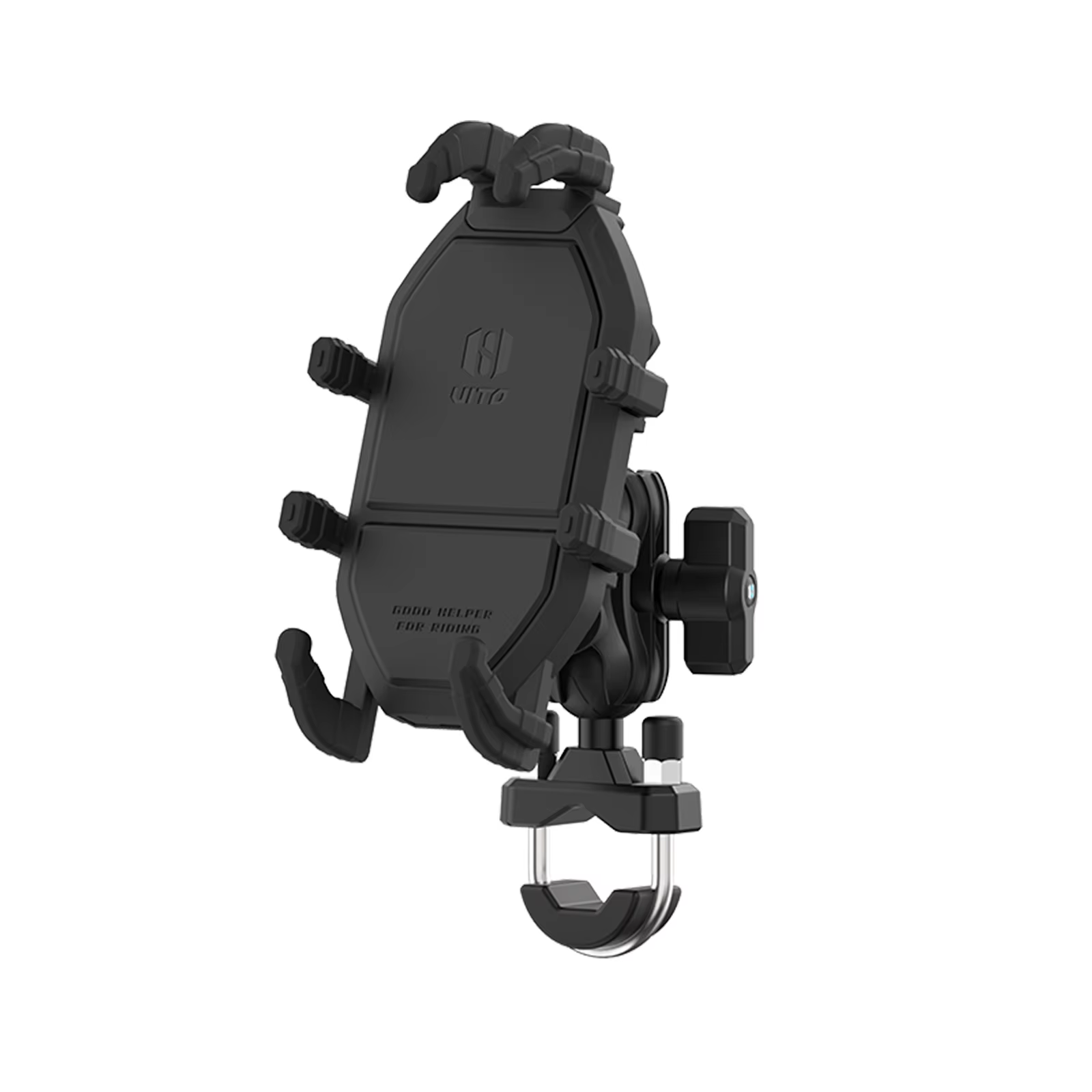
Understanding how a motorcycle mobile phone holder supports different devices requires looking beyond the surface-level clamp mechanism. It involves examining the structural design, clamping range, mounting compatibility, vibration resistance, and material engineering that together determine whether a holder can truly serve a wide range of smartphones without compromising safety or usability. This article breaks down the key mechanisms and design principles that allow a well-engineered motorcycle mobile phone holder to work across diverse device types.
Adjustable Clamping Mechanisms and Width Range
Spring-Loaded and Screw-Tightened Clamp Systems
The most fundamental way a motorcycle mobile phone holder supports different devices is through its clamping mechanism. Spring-loaded clamps use internal tension to grip the phone automatically when inserted, making them fast and convenient for riders who frequently switch between devices. The spring tension is calibrated to hold phones securely without applying excessive pressure that could damage the device frame or screen edges.
Screw-tightened or ratchet-style clamps, on the other hand, allow the rider to manually set the exact grip width. This approach is particularly useful when the device has an unusual thickness or when a protective case adds significant bulk. A motorcycle mobile phone holder with a screw-tightened clamp can be precisely adjusted to match the exact dimensions of the device being used, providing a custom-fit feel regardless of the phone model.
Many premium holders combine both systems — using a spring for initial grip and a locking mechanism to secure the final position. This hybrid approach gives riders the speed of a spring clamp with the precision of a manual adjustment, making the motorcycle mobile phone holder genuinely versatile across a wide device range.
Width and Height Accommodation Range
Device support range is typically defined by the minimum and maximum width the clamp can span. A well-designed motorcycle mobile phone holder will accommodate phones ranging from approximately 55mm to 90mm in width, which covers the vast majority of smartphones currently on the market. This range includes compact 4.7-inch devices at the lower end and large 6.7-inch or 6.9-inch flagship phones at the upper end.
Height accommodation is equally important. Some holders use a four-corner grip design that secures both the top and bottom edges of the phone, while others rely solely on side clamping. Four-corner designs provide superior stability for larger, heavier devices because the load is distributed across multiple contact points rather than concentrated on the sides alone.
When evaluating a motorcycle mobile phone holder for multi-device use, checking the stated width range against the actual dimensions of your devices — including any protective case — is a critical step that many riders overlook until they encounter a fitment problem on the road.
Case Compatibility and Thickness Tolerance
Accommodating Protective Cases of Varying Thickness
Most riders use their smartphones inside protective cases, which adds meaningful thickness and width to the device profile. A motorcycle mobile phone holder that only fits bare phones is of limited practical value. Quality holders are designed with sufficient depth in the clamp arms and enough travel in the adjustment range to accommodate cases ranging from slim 1mm TPU covers to rugged 5mm or 6mm military-grade protective shells.
The clamp arm depth — meaning how far the arm extends inward to grip the phone — determines whether the holder can maintain a secure grip on a cased device without the phone slipping forward or backward under vibration. A shallow clamp arm may grip a bare phone perfectly but fail to hold a thick-cased device securely when the motorcycle hits rough road surfaces.
Riders who use wallet-style cases or battery pack cases face an additional challenge, as these accessories can double the effective thickness of the device. A motorcycle mobile phone holder intended for professional or heavy-use applications should clearly specify its maximum depth tolerance so riders can make an informed selection before purchasing.
Surface Grip Materials and Anti-Slip Design
Beyond dimensional compatibility, the material used on the clamp contact surfaces plays a significant role in how well a motorcycle mobile phone holder supports different devices. Silicone padding is the most common choice because it provides high friction, absorbs micro-vibrations, and does not scratch the phone frame or case surface. The softness of silicone also allows it to conform slightly to irregular surfaces, improving grip on phones with curved edges or textured cases.
Some holders use rubber inserts or foam padding, which offer similar anti-slip properties but may compress over time and lose their grip effectiveness. High-quality silicone retains its properties across a wide temperature range, which is important for a motorcycle mobile phone holder that will be exposed to direct sunlight, cold mornings, and the heat generated by the engine and exhaust.
The combination of adequate clamping force and high-friction contact materials is what allows a single motorcycle mobile phone holder to reliably support devices of different weights, sizes, and surface textures without requiring the rider to make constant adjustments.
Mounting Compatibility Across Handlebar Types
Handlebar Diameter Adaptability
A motorcycle mobile phone holder must not only support the phone itself but also mount securely to the motorcycle's handlebar or stem. Handlebars vary significantly in diameter across different motorcycle types — standard road bikes typically use 22mm bars, while adventure bikes, cruisers, and off-road machines may use 25.4mm or 28.6mm bars. A holder with a fixed-diameter mount will only work on one type of motorcycle, severely limiting its versatility.
Adjustable ball-and-socket mounting bases with multi-diameter clamp adapters allow the same motorcycle mobile phone holder to be transferred between different bikes without purchasing additional hardware. This is particularly valuable for riders who own multiple motorcycles or who frequently rent bikes while traveling.
The mounting clamp should use a secure tightening mechanism — typically a hex bolt or a quick-release lever — that can be firmly locked without over-torquing the handlebar. Proper mounting torque is important because an under-tightened mount will allow the entire motorcycle mobile phone holder assembly to rotate or shift under vibration, while an over-tightened mount can damage the handlebar finish or, in extreme cases, deform the bar itself.
Stem and Mirror Mount Options
Not all riders prefer handlebar mounting. Some motorcycles have limited handlebar space due to controls, switches, or ergonomic preferences, making stem mounting or mirror-post mounting a more practical option. A motorcycle mobile phone holder designed for multi-position mounting will include adapter plates or secondary clamps that allow it to attach to the steering stem, the mirror post, or even a dedicated RAM-style mounting ball.
Stem mounting positions the phone closer to the rider's line of sight and away from the vibration-intensive handlebar ends, which can improve both visibility and device longevity. Mirror-post mounting is popular on scooters and smaller displacement bikes where the handlebar area is compact and crowded with controls.
The flexibility of the mounting system directly affects how well a motorcycle mobile phone holder integrates into different riding setups, and riders should evaluate mounting options alongside device compatibility when selecting a holder for multi-bike or multi-device use.
Vibration Damping and Device Protection
How Vibration Affects Different Devices
Motorcycle engines generate significant vibration, and this vibration is transmitted through the frame and handlebars to anything mounted on the bike — including a motorcycle mobile phone holder and the device it carries. High-frequency vibration is particularly damaging to smartphone optical image stabilization (OIS) systems, which use small gyroscopic mechanisms that can be degraded by sustained resonant vibration at specific frequencies.
Heavier phones are more susceptible to vibration-induced movement within the clamp because their greater mass amplifies the inertial forces acting on the holder. A motorcycle mobile phone holder that performs well with a lightweight 150-gram phone may allow a 220-gram flagship device to bounce or shift noticeably on rough roads if the clamping force and damping design are not adequate for the heavier load.
Understanding this relationship between device weight and vibration behavior helps riders select a motorcycle mobile phone holder with appropriate clamping strength and damping characteristics for their specific device, rather than assuming that any holder will perform equally well with any phone.
Damping Materials and Structural Rigidity
Effective vibration damping in a motorcycle mobile phone holder is achieved through a combination of material selection and structural design. Holders constructed from high-grade aluminum alloy or reinforced ABS plastic with internal rubber damping inserts at the mounting interface can significantly reduce the amplitude of vibration transmitted to the phone. The rubber inserts act as a mechanical buffer between the rigid mounting clamp and the holder body, absorbing energy before it reaches the device.
Ball-joint connections between the mounting arm and the holder body also contribute to vibration isolation by allowing micro-movements that dissipate energy rather than transmitting it directly. A stiff, fully rigid connection between the mount and the phone clamp creates a direct vibration pathway, while a joint with controlled compliance breaks that pathway and reduces the peak vibration amplitude experienced by the device.
For riders who cover long distances or frequently ride on unpaved roads, investing in a motorcycle mobile phone holder with dedicated vibration damping features is a practical decision that protects the device and maintains a stable, readable display throughout the ride.
Orientation Flexibility and Viewing Angle Adjustment
Portrait and Landscape Mode Support
Different navigation apps, riding apps, and communication tools display optimally in different screen orientations. A motorcycle mobile phone holder that supports both portrait and landscape orientations gives the rider the flexibility to use their preferred app layout without being constrained by the holder's fixed position. This is particularly relevant for riders who use dedicated GPS navigation apps that display better in landscape mode versus communication or music apps that are designed for portrait use.
Orientation switching is typically enabled by a 360-degree rotating clamp body that can be locked at any angle. The locking mechanism must be firm enough to hold the selected orientation under vibration and wind pressure, but smooth enough to allow easy repositioning when the rider stops and wants to switch apps or change the viewing angle.
A motorcycle mobile phone holder with a well-engineered rotation lock provides genuine multi-device support in the functional sense — not just accommodating different physical sizes, but also adapting to the different usage patterns associated with different devices and applications.
Tilt and Angle Adjustment for Glare Reduction
Screen glare is a significant usability challenge for any motorcycle mobile phone holder used in outdoor conditions. The angle of the sun relative to the screen changes throughout the day and varies with the direction of travel, meaning that a fixed-angle holder will produce glare at certain times regardless of screen brightness settings. A holder with a tiltable arm or an adjustable ball joint allows the rider to fine-tune the screen angle to minimize glare without stopping the motorcycle.
Different devices also have different screen technologies — OLED screens, for example, have different viewing angle characteristics than LCD screens — which means the optimal tilt angle for glare reduction may differ between devices even when mounted in the same position. A motorcycle mobile phone holder with a wide tilt range accommodates these differences and allows each device to be positioned at its optimal viewing angle.
The practical result is that a well-designed motorcycle mobile phone holder does not just hold the phone — it actively supports the rider's ability to use the device effectively across different lighting conditions, device types, and riding scenarios.
FAQ
Can a motorcycle mobile phone holder fit phones with thick protective cases?
Yes, most quality motorcycle mobile phone holder designs include sufficient clamping range and arm depth to accommodate phones inside standard protective cases. However, very thick cases such as battery pack cases or rugged multi-layer cases may exceed the maximum grip range of some holders. Always check the holder's stated maximum width and depth tolerance against your cased device dimensions before purchasing.
How does a motorcycle mobile phone holder handle larger flagship phones without slipping?
Larger phones are supported through a combination of adequate clamping force, high-friction silicone contact pads, and in some designs, a four-corner grip system that distributes the phone's weight across multiple contact points. Holders with spring-loaded clamps calibrated for heavier devices and vibration-damping materials at the mount interface provide the most reliable grip for large flagship smartphones during extended rides.
Is it safe to use a motorcycle mobile phone holder on any type of handlebar?
A motorcycle mobile phone holder with an adjustable mounting clamp can be safely used on handlebars of different diameters, typically ranging from 22mm to 28.6mm, using the appropriate adapter. The key safety requirement is that the mounting clamp is tightened to the correct torque — firm enough to prevent rotation or shifting under vibration, but not so tight that it damages the handlebar surface or finish.
Does vibration from the motorcycle engine damage the phone when using a motorcycle mobile phone holder?
Sustained high-frequency vibration can potentially affect smartphone components, particularly optical image stabilization systems, over time. A motorcycle mobile phone holder with built-in vibration damping — such as rubber inserts at the mounting interface or a compliant ball-joint connection — significantly reduces the vibration transmitted to the device. For long-distance riders or those who frequently ride on rough roads, choosing a holder with dedicated damping features is a worthwhile precaution.